For years, directory SEO had a simple recipe. Generate a page for every city and every category, cross your fingers, and let sheer volume do the work.
That recipe has aged about as well as a prawn sandwich left in a warm car.
Search engines have become much better at spotting pages that exist only to exist. And now there's a second audience to think about, because people increasingly ask AI assistants for recommendations rather than scrolling through ten blue links.
The good news is that you don't need two separate strategies. Nearly everything that helps with one helps with the other. It comes down to one idea, which is annoyingly simple: be the most useful page on the subject.
Here's how that works in practice.
Start with the unglamorous basics
Nothing else matters if search engines can't read your site properly, so get these right first. They aren't exciting, but neither are foundations, and you still want them under your house.
- Clean URLs.
/dentists/lisbontells people and search engines what's on the page./page.php?id=7731&cat=4tells them nothing. - A sitemap so new listings get discovered.
- Unique titles and descriptions on every important page.
- Speed. Nobody has ever said, "I love how long this directory takes to load."
- A site that works on phones. Local searches very often happen on one, usually while walking and mildly lost.
Kill the thin pages before they kill you
This is the biggest trap for directories. Imagine you have 200 cities and 50 categories. That's 10,000 possible pages, and most of them will contain one listing, or none, plus a cheerful message saying "no results found."
From a search engine's point of view, that's a warehouse full of empty boxes. Enough of those and the whole site starts to look low quality, including your good pages.
Our rule of thumb: a page should earn its place. If a category and city page has a healthy number of real listings, keep it open to search engines. If it's empty, keep it out of the index until it has something to show.
Then make your best pages better. A location page with a short, genuinely local introduction will beat a bare list almost every time. "Most of the wedding venues in the Douro Valley are working vineyards, so book early for harvest season" isn't something a template writes. That's the point.
Make every listing worth reading
A listing with a name, a phone number and two lines of copied text gives a search engine nothing it doesn't have already. The same goes for an AI assistant.
Rich listings stand out because they include details that aren't everywhere else:
- Services offered, in plain language
- Who the business is best suited for
- Opening hours, area covered and languages spoken
- Real photos, not stock images of people laughing at salads
- Reviews from actual customers
Encourage owners to fill all of it in. A simple trick is to show them a profile completeness score, or to reserve the best placements for complete listings. Businesses will do remarkable things to avoid looking half-finished.
Speak machine as well as human
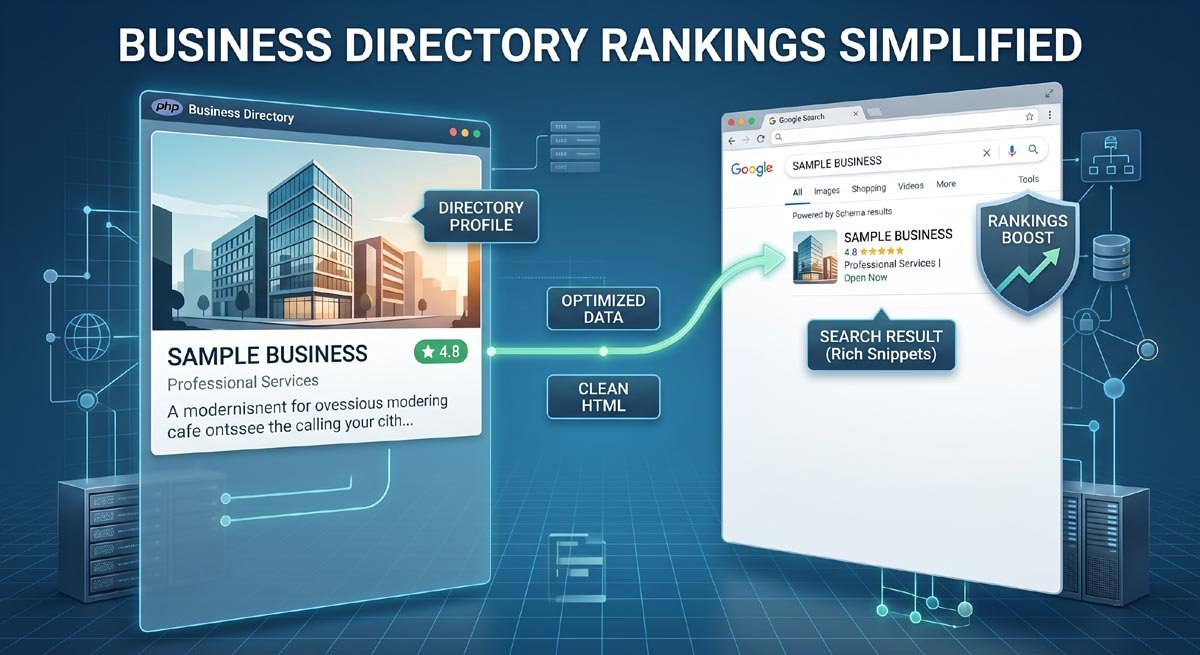
Schema markup is a small piece of code that labels your information for machines: this is a business, this is its address, this is its rating. Visitors never see it, but it removes the guesswork for anything trying to understand your page.
For a directory, the key types are LocalBusiness for listings, AggregateRating for review scores, and BreadcrumbList to show how your pages fit together. It can also help your pages appear in search with extras such as star ratings, although Google decides when to show them.
If you use PHP Business Directory, this is built in. If you don't, it's worth checking whether your software outputs it, because adding it by hand across thousands of listings is nobody's idea of a good weekend.
What changes with AI search
Now for the part everyone's asking about. How do you get an AI assistant to mention your directory?
We'd love to give you a secret formula, but nobody outside these companies knows exactly how each system chooses its sources, and anyone selling you a guaranteed method is selling you something else. What we can do is look at how these answers work and improve your odds.
AI assistants try to give a direct answer to a specific question, and many of them draw on web pages to do it. That favors content which is clear, specific and easy to quote. In practice:
Answer questions directly. If your page is about choosing a dentist for nervous children, say something useful in the first few lines. Don't open with 200 words about the history of teeth.
Use real questions as headings. "How much does a wedding photographer cost in Porto?" is a heading an AI system, and a human, can use immediately.
Add what only you know. Anybody can list businesses. Fewer people can say which ones have wheelchair access or which clinics currently accept new patients. Original, first-hand details are the hardest thing to replace.
Be consistent. Keep business details accurate and consistent. Conflicting information is a good way to get ignored.
Don't block the door by accident. Check your robots.txt file to make sure that you aren't blocking crawlers you actually want visiting your site.
The aim isn't to trick an AI. It's to be the source it would be silly to ignore.
Publish things worth linking to
Links from other websites still matter, and directories have a nice advantage here: they can create useful local resources that people want to share.
Try a yearly guide to the best businesses in your niche, a simple cost guide, or a straightforward "how to choose" article. Local newspapers, bloggers and associations will link to genuinely helpful resources much more readily than they'll link to your homepage.
And don't forget the businesses themselves. Offer each listed business a small "Find us on..." badge for its website. Some will use it, and those links come from relevant local sites. That's the good stuff.
You can run all of this from a built-in blog on your own domain, so every useful article strengthens the site you actually own.
A simple plan for the next 90 days
If that all feels like a lot, here's a sensible order to tackle it in.
- Weeks 1 to 2: fix the basics. Check speed, mobile display, titles and your sitemap.
- Weeks 3 to 4: find thin and empty pages, and keep them out of the index until they're useful.
- Weeks 5 to 8: improve your 20 most important pages with real local detail.
- Weeks 9 to 12: publish three to five genuinely useful guides, and tell the people who'd care.
Then measure what happened in Google Search Console, adjust and repeat. SEO rewards patience, which is a shame, because hardly anyone has any.
The short version
Don't try to win by being bigger. Win by being more useful, more accurate and more specific than anyone else in your niche. That's what search engines have been trying to reward for years, and it's what AI assistants need in order to give a good answer.
Still choosing your niche? That decision will affect everything above, so read why niche directories win next. Or see the SEO tools in the live demo, if you'd rather poke at the real thing.